The Evolution of Dragon Ball Games: From 8-Bit to Next-Gen
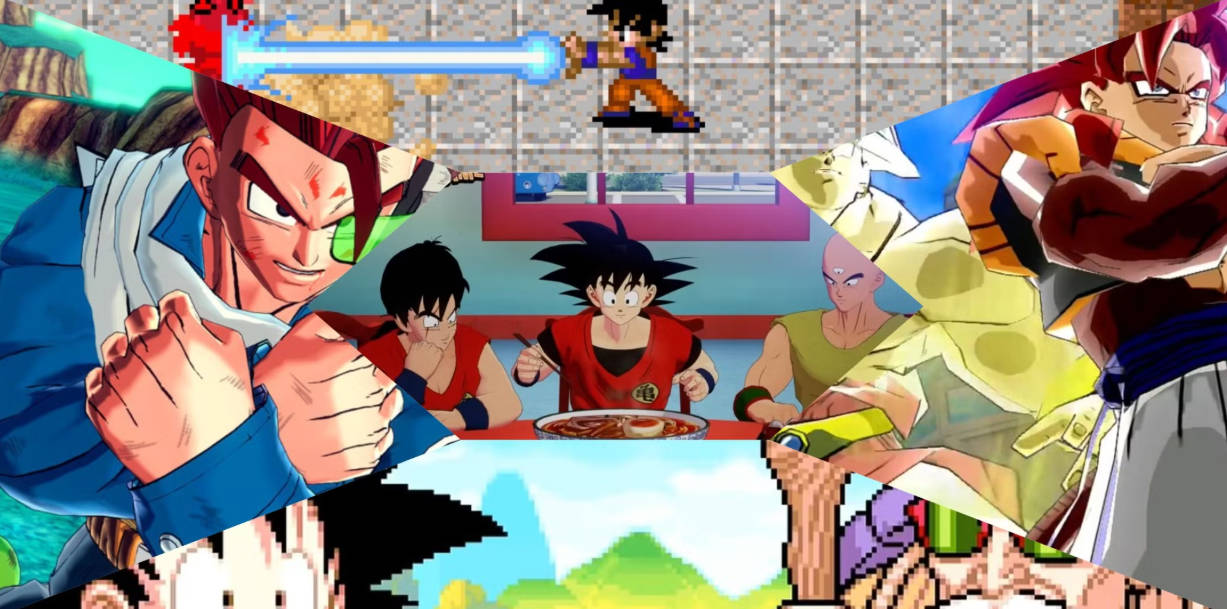
A Comprehensive Look at 30 Years of Dragon Ball Gaming
Since the first Dragon Ball game was released in 1986, the franchise has seen over 100 games across nearly every gaming platform imaginable. From simple 8-bit adaptations to today’s cutting-edge 3D fighters, Dragon Ball games have evolved dramatically over the years.
The Early Years (1986-1995)
The first Dragon Ball games were simple 8-bit titles released for the Nintendo Entertainment System (Famicom) in Japan. These games were primarily action-platformers or simple fighting games that loosely adapted the early Dragon Ball manga and anime.
- Dragon Ball: Dragon Daihikyō (1986): The first ever Dragon Ball game, a board game-style title for the Famicom.
- Dragon Ball 3: Goku Den (1989): Considered by many to be the first truly great Dragon Ball game, featuring a mix of action and RPG elements.
- Dragon Ball Z: Kyōshū! Saiyan (1990): The first game based on Dragon Ball Z, introducing the series’ signature fighting mechanics.
The 16-Bit Era (1995-2000)
With the advent of 16-bit consoles like the Super Nintendo (Super Famicom) and Sega Genesis, Dragon Ball games began to feature more detailed graphics and complex gameplay mechanics.
- Dragon Ball Z: Super Butōden (1993): The first Dragon Ball Z fighting game for the Super Famicom, introducing the series’ now-iconic 2D fighting mechanics.
- Dragon Ball Z: Hyper Dimension (1996): Often considered one of the best 2D Dragon Ball fighting games, featuring a roster of 12 characters and detailed sprite work.
- Dragon Ball GT: Final Bout (1997): The first Dragon Ball game to feature 3D graphics, though the gameplay was still primarily 2D.
The 32-Bit and 64-Bit Era (2000-2005)
With the transition to 32-bit and 64-bit consoles, Dragon Ball games began to fully embrace 3D graphics and more complex gameplay mechanics.
- Dragon Ball Z: Budokai (2002): The first Dragon Ball Z game for the PlayStation 2, introducing a new 3D fighting system that would become the foundation for future games.
- Dragon Ball Z: Budokai Tenkaichi (2005): A revolutionary game that introduced a fully 3D combat system with destructible environments and a massive roster of over 60 characters.
The Seventh Generation (2005-2012)
The seventh generation of consoles (PlayStation 3, Xbox 360, Wii) saw Dragon Ball games reach new heights in terms of graphics and gameplay complexity.
- Dragon Ball Z: Budokai Tenkaichi 3 (2007): The culmination of the Budokai Tenkaichi series, featuring over 160 characters and a comprehensive story mode.
- Dragon Ball: Raging Blast (2009): A next-generation update to the Budokai Tenkaichi formula, featuring enhanced graphics and new gameplay mechanics.
- Dragon Ball Z: Ultimate Tenkaichi (2011): A controversial entry that attempted to simplify the gameplay while introducing a character creation system.
The Eighth Generation (2012-2020)
The eighth generation of consoles (PlayStation 4, Xbox One, Nintendo Switch) brought significant improvements in graphics and allowed for more ambitious game designs.
- Dragon Ball Xenoverse (2015): A groundbreaking game that introduced a fully customizable character and an original story set in the Dragon Ball universe.
- Dragon Ball Xenoverse 2 (2016): A sequel that expanded on the original with improved graphics, more characters, and a larger hub world.
- Dragon Ball FighterZ (2018): A critically acclaimed fighting game developed by Arc System Works, featuring stunning 2D graphics and deep gameplay mechanics.
- Dragon Ball Z: Kakarot (2020): An open-world action RPG that tells the complete story of Dragon Ball Z, from the Saiyan Saga to the Buu Saga.
The Current Generation (2020-Present)
The current generation of consoles (PlayStation 5, Xbox Series X/S) has allowed Dragon Ball games to reach new levels of visual fidelity and gameplay complexity.
- Dragon Ball Z: Kakarot - DLCs (2021-2024): A series of DLCs that expanded the game to include the Dragon Ball Super Broly movie and the Tournament of Power arc.
- Dragon Ball: The Breakers (2022): A unique asymmetrical multiplayer game where players either control a powerful villain or a group of survivors trying to escape.
- Dragon Ball Xenoverse 3 (2024): The highly anticipated sequel to Xenoverse 2, featuring enhanced graphics and new gameplay mechanics.
The Future of Dragon Ball Games
Looking ahead, the future of Dragon Ball games looks bright, with several exciting projects in development:
- Dragon Ball: Legacy of the Super Saiyans (2027): An open-world action RPG allowing players to create their own Saiyan character.
- Dragon Ball FighterZ 2 (TBA): The sequel to the critically acclaimed fighting game, expected to feature a new roster of characters and enhanced gameplay mechanics.
- Dragon Ball Z: Kakarot - GT Saga (2026): A DLC for Dragon Ball Z: Kakarot that will adapt the Dragon Ball GT series.
Impact on the Gaming Industry
Dragon Ball games have had a significant impact on the gaming industry, popularizing the anime fighting game genre and introducing millions of players to the world of competitive gaming. The series’ success has also paved the way for other anime-based games, demonstrating that licensed games can be both critically acclaimed and commercially successful.
Fan Community
The Dragon Ball gaming community is one of the most passionate and dedicated in the industry, with active online communities, tournaments, and fan-made content. This community has played a significant role in the evolution of Dragon Ball games, providing feedback to developers and helping to shape the future of the franchise.